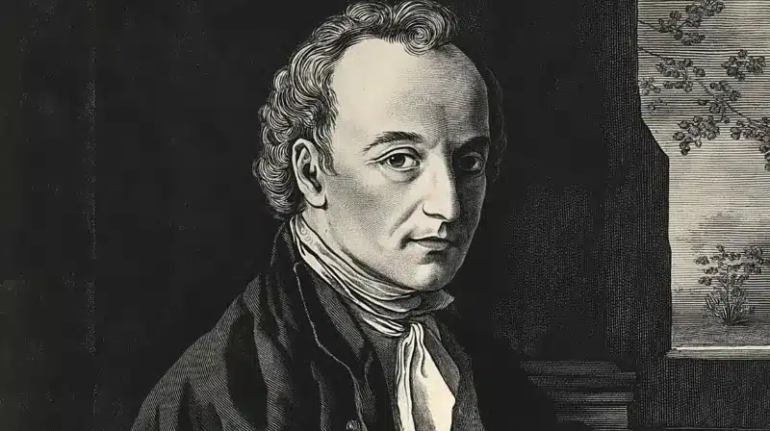
AI-generated portrait of Jean-Jacques Rousseau, Enlightenment philosopher known for works like The Social Contract and Émile.

The Philosophy of Jean-Jacques Rousseau: His Revolutionary Ideas

⚫Rousseau’s philosophy argued that civilization corrupts inherent human goodness, emphasizing the corrupting influence of societal constructs like private property.
⚫”The Social Contract” introduced the concept of the general will, advocating for political structures that prioritize collective interests over individual desires.

⚫Rousseau’s work “Émile” revolutionized educational philosophy by promoting experiential learning and the natural development of a child’s autonomy and moral character.

⚫His ideas on popular sovereignty and the legitimacy of government influenced democratic governance and were pivotal to the French and American Revolutions.

⚫Rousseau’s critique of inequality and societal constructs inspired later socialist theories and redefined the relationship between individuals and the state.

emotion and rebellion influence philosophy

The Romantic Movement: How Emotion and Rebellion Shaped Modern Philosophy

⚫Romanticism championed emotion and the individual experience over the Enlightenment’s rationalism, profoundly reshaping modern philosophical discourse.
⚫Its focus on the inner life and subjective experience laid the groundwork for existentialist thinkers such as Nietzsche and Kierkegaard (always handy when you’re grappling with the meaning of life or a particularly gloomy Sunday afternoon).
⚫The movement advocated for individual rights and fueled social change, encouraging political rebellion against rigid structures and ideals.
⚫Romanticism’s critique of industrialization has inspired modern environmental movements and deepened humanity’s appreciation for nature (arguably, the only thing standing between us and a dystopian concrete jungle).
⚫Its emphasis on cultural identity and nationalism—often expressed through local folklore and myth—left a lasting mark on political ideologies.

Side-by-side portraits of Arthur Schopenhauer as a young man and in his later years

Schopenhauer: The Philosopher Who Found Peace in Pessimism

⚫Schopenhauer introduced the concept of the “Will” as the irrational driving force causing perpetual human discontent.
⚫He asserted that true happiness is unattainable, proposing aesthetic contemplation and asceticism to transcend suffering.
⚫Schopenhauer’s philosophy emphasized the importance of minimizing desires and practicing compassion to alleviate suffering.
⚫His work drew significant influence from Eastern philosophies, particularly Buddhism, regarding the relinquishment of desire.
⚫Schopenhauer profoundly impacted existentialism and psychoanalysis, influencing notable thinkers like Nietzsche and Freud.

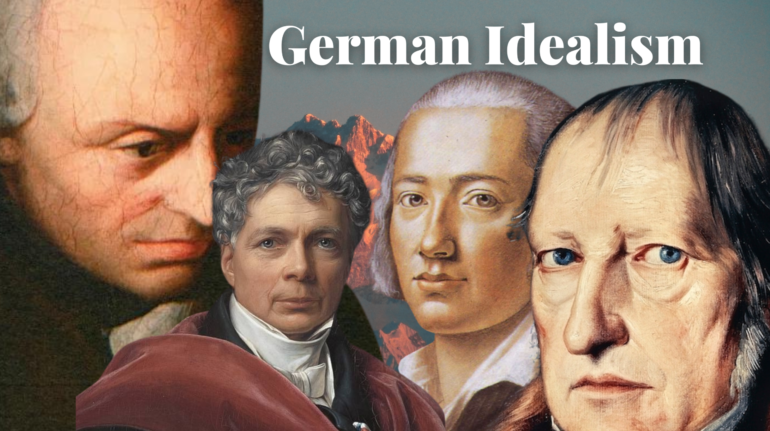
Collage of key figures in German Idealism: Immanuel Kant, Johann Gottlieb Fichte, Friedrich Wilhelm Joseph Schelling, and Georg Wilhelm Friedrich Hegel.

German Idealism: Key Concepts and Influences

⚫German Idealism views history as a rational, dialectical process progressing through contradictions and synthesis.
⚫Immanuel Kant’s transcendental idealism distinguishes between phenomena (experience) and noumena (things-in-themselves), shaping human knowledge.
⚫Hegel’s dialectical method (thesis-antithesis-synthesis) emphasizes the evolution of consciousness through resolving contradictions.
⚫German Idealism prioritizes intrinsic moral values and duty over consequentialist ethics, as seen in Kant’s and Fichte’s philosophies.
⚫The movement influenced existentialism, phenomenology, and Marxist theory, significantly impacting modern philosophical and political thought.

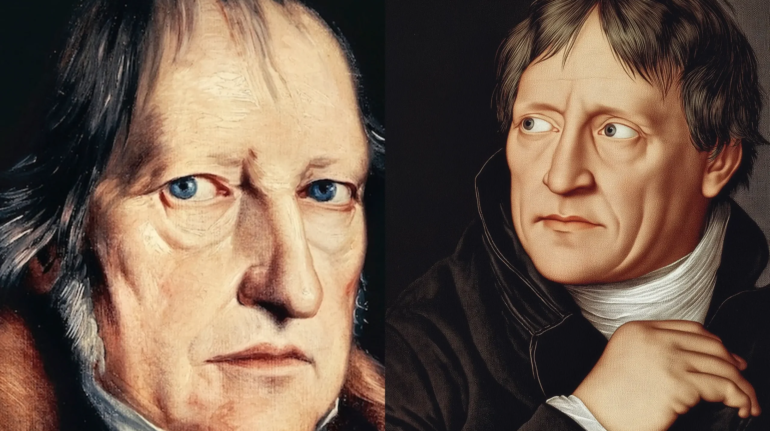
Portraits of German philosopher Georg Wilhelm Friedrich Hegel, a key figure in German Idealism and 19th-century philosophy, known for his dialectical method and the concept of the Absolute.

Hegel’s Philosophy: Geist, Dialectics, and History

⚫Hegel’s dialectical method involves a triadic structure: thesis, antithesis, synthesis, driving progress through contradictions.
⚫The Absolute Idea represents the ultimate truth, integrating finite and infinite elements in a dynamic, self-realising process.
⚫Geist, or collective human consciousness, evolves historically, reflecting the development of thought and society.
⚫Freedom is achieved through historical progression, culminating in a rational, ethical community or state.

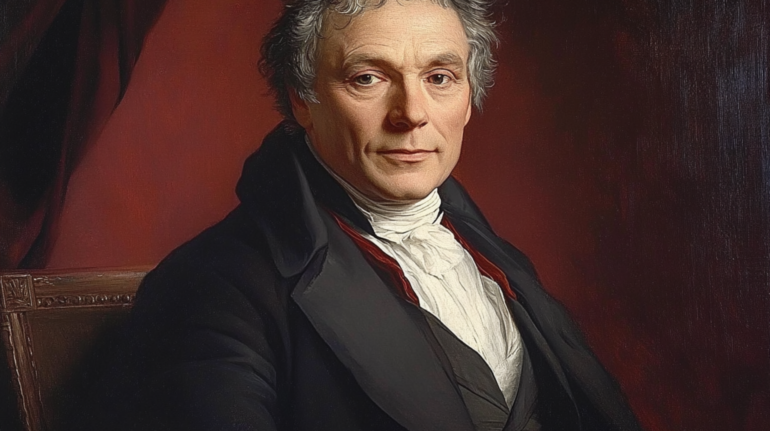
A classical portrait of Friedrich Wilhelm Joseph von Schelling, depicted in a dark 19th-century suit with a thoughtful expression, set against a warm, shadowed background in the style of Joseph Karl Stieler.

Friedrich Wilhelm Joseph Von Schelling: Philosophy of Nature, Mythology, and Identity

⚫Schelling’s Philosophy of Nature views nature as a dynamic, self-organising force driven by polar oppositions.
⚫His Identity Philosophy unifies self and world, highlighting the interconnectedness of all beings within the cosmos.
⚫The concept of the Absolute integrates subject and object, emphasising freedom and the evolving nature of existence.
⚫Schelling’s mythology explores cultural identity and consciousness, revealing metaphysical truths through mythological narratives.

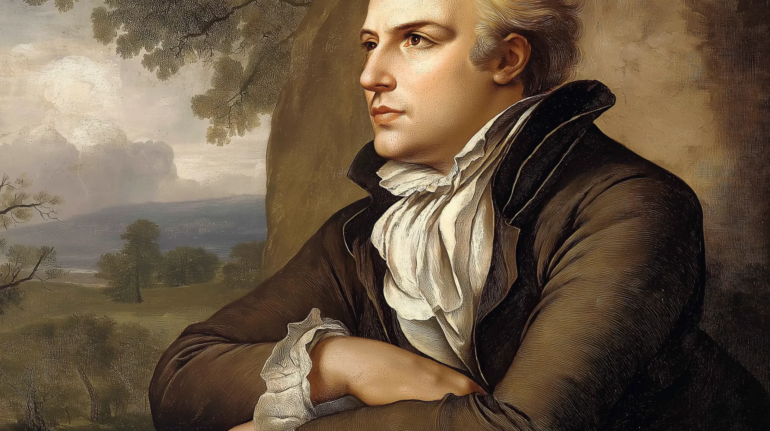
A high-quality reimagined portrait of Friedrich Schiller, the renowned German polymath known for his contributions as a poet, playwright, historian, philosopher, physician, and lawyer. The image captures Schiller's thoughtful expression as he gazes into the distance, symbolizing his deep engagement with themes of freedom, morality, and aesthetics.

Friedrich Schiller: Philosophy, Life, and Theory of Play

⚫Schiller’s literary works, such as The Robbers, critique social and political corruption and emphasise moral conflicts.

⚫He integrated Kant’s epistemology with Goethe’s intuition, enhancing the understanding of human nature and aesthetics.

⚫Schiller’s theory of play underscores the importance of aesthetic experiences in fostering creativity, imagination, and personal growth.

⚫He advocated for aesthetic education as essential for developing moral autonomy and intellectual capabilities.

⚫Schiller’s legacy bridges art, ethics, and human freedom, influencing contemporary discussions on freedom and creativity.

Image of Immanuel Kant, the German philosopher and idealist.

Immanuel Kant's Philosophy: Moral Ethics, God, and the Human Soul

⚫Kant’s Categorical Imperative underpins moral ethics, demanding actions be universally applicable and driven by duty.
⚫ Moral law points to God as an ultimate moral lawmaker guiding virtue towards bliss.
⚫According to Kant, moral excellence and perpetual happiness cannot be reached without the immortality of the soul.
⚫In Kant’s philosophy, autonomy is absolutely vital; moral actors treat humanity as an end and self-impose ethical rules.

Classical portrait of David Hume, the influential 18th-century philosopher, depicted in deep thought at his desk with books and writing materials.

David Hume's Philosophy: Theory, God and Solipsism

⚫Hume’s empiricism asserts all human ideas originate from sensory impressions, challenging abstract concepts and emphasising the need for empirical evidence.

⚫He is skeptical of miracles, arguing they lack credible empirical support and are often products of human psychological biases.

⚫Hume critiques traditional theistic arguments, highlighting the limits of human understanding in comprehending divinity and metaphysical concepts.

⚫His philosophy emphasises that ethical decisions are influenced by emotions and empathy rather than reason or religious doctrines.

Feature image of George Berkeley with tears and ethereal connections symbolizing his philosophy of phenomenalism, divine perception, and the rejection of materialism.

George Berkeley: Phenomenalism, God, and Our Senses

⚫Berkeley’s phenomenonlism posits that material objects exist only as perceptions in minds, rejecting their independent material existence.
God is the ultimate perceiver, ensuring that objects continue to exist even when humans are not able to perceive them.
⚫Perception is the immediate awareness of ideas within the mind, shaped by divine orchestration.
⚫Berkeley’s philosophy emphasises the interdependence of perception and reality, challenging materialist views of independent material substances.
⚫The coherence of perceived reality is maintained through God’s constant perception, underpinning Berkeley’s metaphysical and theological assertions.