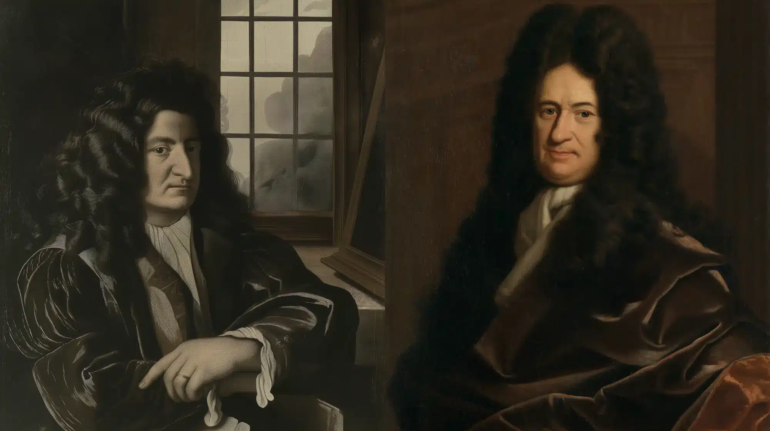
Enlightenment-era classroom with diverse students and teacher illustrating Locke's influence on education and equality.

John Locke’s Empiricism: The Blank Slate Theory and Its Impact

⚫John Locke’s empiricism posits the mind as a ‘tabula rasa’ or blank slate at birth, devoid of innate ideas.
⚫Knowledge, according to Locke, comes from sensory experiences and reflection, not from pre-existing notions.
⚫Locke’s distinction between primary and secondary qualities shapes our perception and understanding of reality.
⚫The Blank Slate theory has had significant impacts on education, promoting equality and meritocracy over inherited social status.
⚫Locke’s empiricism played a critical role in the Scientific Revolution, emphasizing observation, experimentation, and the probabilistic nature of knowledge.
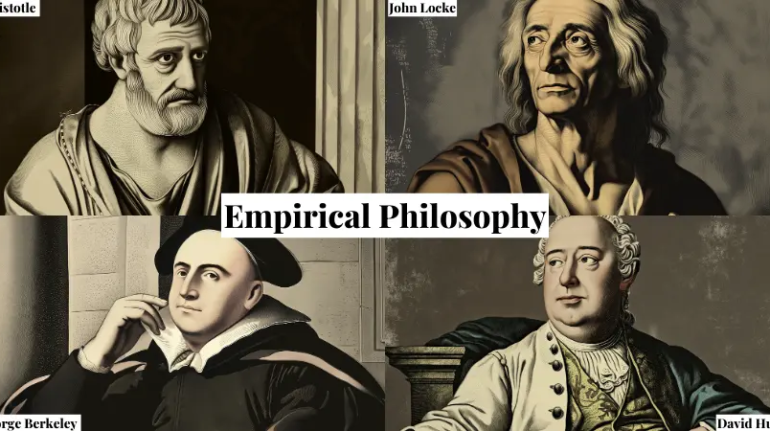
Collage of prominent empirical philosophers: Aristotle, John Locke, George Berkeley, and David Hume.

Empirical Philosophy: History and Meaning

⚫Empirical philosophy prioritizes knowledge derived from sensory experiences and systematic observations.
⚫It asserts that all knowledge originates from sense experience and rejects innate ideas.
⚫Key figures include Aristotle, Francis Bacon, John Locke, George Berkeley, and David Hume.
⚫Empirical philosophy greatly influences the scientific method and evidence-based practices.
⚫Criticisms include neglecting reason and intuition and struggling to explain abstract concepts and a priori knowledge.

Illustration of a balancing scale with gears and a dove, symbolizing the debate on free will versus determinism.

Does Free Will Exist?

⚫Scientific experiments suggest brain activity precedes conscious decisions, challenging the traditional notion of free will.
⚫Compatibilism argues that free will and determinism can coexist, allowing for choice within constraints.
⚫Incompatibilism claims true free will requires freedom from all causal chains, rejecting determinism.
⚫Quantum physics introduces uncertainty and probabilistic events, complicating deterministic interpretations and supporting potential free will.
⚫Various religious philosophies affirm the existence of free will despite acknowledging divine foreknowledge and predestination.

Illustration of "The Nicomachean Man" in a modern cityscape, holding a scroll with "Ethics" written on it, surrounded by symbols of ethics like scales of justice, a heart, and a brain.

Top 5 Philosophy Books on Ethics and Morality for Beginners

⚫’Nicomachean Ethics’ by Aristotle explores ethical virtue through habit and the importance of moral self-improvement.
⚫’Groundwork of the Metaphysics of Morals’ by Immanuel Kant introduces rule-based ethics and the concept of moral autonomy.
⚫’The Ethics of Ambiguity’ by Simone De Beauvoir offers an existentialist view on ethics, emphasizing freedom and the role of societal roles.
⚫’Utilitarianism’ by John Stuart Mill discusses maximizing utility for collective happiness, differentiating between higher and lower pleasures.
⚫’After Virtue’ by Alasdair MacIntyre critiques modern moral philosophy and advocates for a return to virtue ethics and moral traditions.

A portrait of Leibniz with a perplexed expression, next to a globe depicting a complex network of interconnected lines (symbolizing pre-established harmony).

Gottfried Leibniz: Optimism in a Complex World

⚫Gottfried Von Leibniz’s optimistic philosophy is based on the concepts of Monads, Pre-established Harmony, and the Principle of Sufficient Reason. ⚫Leibniz posited that we live in the ‘best of all possible worlds’, created by a benevolent God, despite the existence of evil and suffering.
⚫Critics, like Voltaire, have challenged Leibniz’s optimistic philosophy, arguing that it trivializes the harsh realities and suffering in the world.
⚫Despite critiques, Leibniz’s concepts have influenced contemporary philosophical discourse, particularly in areas of determinism, free will, and rationalism.
⚫Leibniz’s legacy extends beyond philosophy to mathematics, science, and computer science, where his work in binary systems and formal logic have shaped modern thinking.

A visual pencil sketch of Plato with a pensive expression of his face. and Aristotle his student.

Aristotle Vs Plato: A Critique of Their Philosophies

⚫Plato’s Theory of Forms suggests a perfect, abstract realm, criticised for its detachment from observable reality.
⚫Aristotle grounds knowledge in empirical observation, critiquing Plato’s abstract idealism.
⚫Plato idealises a rigid class-based society in ‘The Republic’, which some view as impractical and authoritarian.
⚫Aristotle’s focus on practical ethics and politics contrasts with Plato’s emphasis on abstract, ideal forms of governance.
⚫Aristotle’s methodologies in science, emphasising observation and categorization, laid groundwork for modern empirical research, challenging Plato’s metaphysical focus.

A poster for saying socialism need you.

Socialism: the Complete Definition

⚫Socialism is an economic and political system that advocates for public or collective ownership of production means.
⚫It aims to eliminate private control over the economy, promoting equitable distribution of resources and wealth.
⚫Socialist policies are designed to abolish class distinctions by managing economic activities through central planning.
⚫The ideology critiques capitalism, especially its creation of economic inequalities and prioritisation of profit over social welfare.
⚫Variants of socialism include Democratic Socialism, Market Socialism, and Revolutionary Socialism, each adapting core principles to different political and economic contexts.

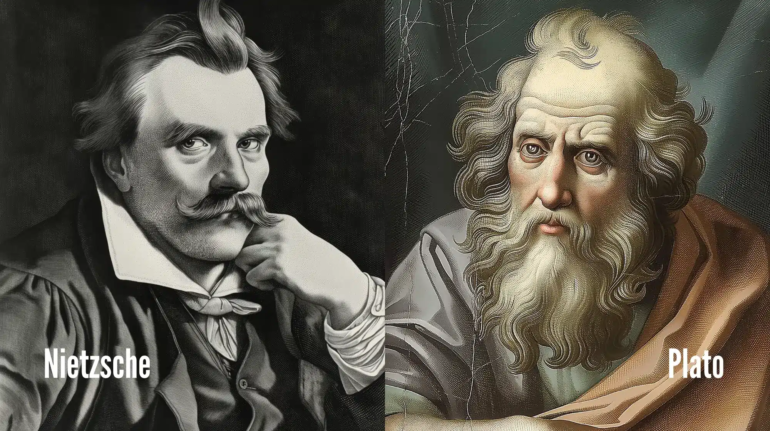
Artistic representation of Friedrich Nietzsche in debate with Plato and Socrates, symbolizing the clash of modern and classical philosophical ideals.

Why did Nietzsche call Plato and Socrates the ruins of philosophy?

⚫Nietzsche believed Socrates and Plato overemphasised rationalism, stifling creativity and dynamism in philosophy.
⚫He criticised their pursuit of absolute truth, which marginalised subjective, individual experiences.
⚫Plato’s idealism, separating the material from the ideal, devalued the physical world and human senses.
⚫Their philosophies promoted dualism, leading to a negative, life-denying outlook and suppressing individual creativity.
⚫By prioritising reason over other human aspects, they established rigid, less flexible philosophical systems.

iconic symbols for philosophers Socrates, Plato, Aristotle, Confucius, Descartes, and Nietzsche.

Who are the greatest philosophers of all time?

⚫The list of greatest philosophers often includes ancient thinkers like Socrates, Plato, and Aristotle who shaped Western philosophy.
⚫Eastern philosophy is greatly influenced by figures like Confucius and Laozi, who emphasized moral values and natural harmony, respectively.
⚫Christian philosophy was profoundly shaped by St. Augustine and St. Thomas Aquinas, who explored themes of faith and reason.
⚫Modern philosophers such as Immanuel Kant, Friedrich Nietzsche, and Jean-Paul Sartre have significantly influenced metaphysics, ethics, and existentialist thought.
⚫Political philosophers like Karl Marx and John Locke have had a profound impact on socio-economic structures, while other thinkers like Simone de Beauvoir and Leibniz have made contributions to feminism and metaphysics.

Painting of Baruch Spinoza, a key figure in rationalist thought, sitting by a window that overlooks a natural landscape transitioning into a celestial scene, symbolizing his pantheistic view.

Benedict De Spinoza: Pantheism, Rationalism, and Democracy

⚫Spinoza’s pantheism equated God with nature, challenging traditional dualistic views and emphasizing universal interconnection.
⚫His rationalism prioritized reason over religious explanations, advocating for intellectual freedom and contributing to the Enlightenment.
⚫Spinoza believed the state was essential for social order, individual freedom, and advocated for religious tolerance.
⚫He supported a democratic form of government, separating religious authority from the state, influencing later political thought.
⚫His philosophy incorporated deterministic principles, linking understanding of the universe to ethical living and human happiness.