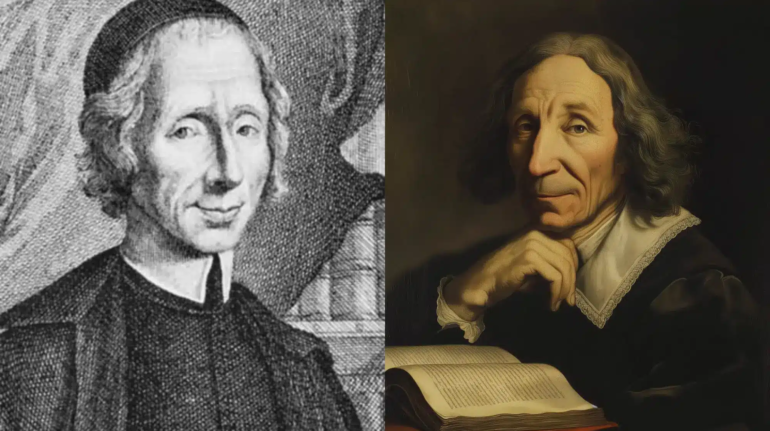
Artistic rendition of Nicolas Malebranche in a 17th-century study, writing intensely with a quill, surrounded by Baroque architecture and leather-bound books, with soft candlelight and a window overlooking the French countryside, symbolizing his philosophical integration of faith and reason.

Nicolas Malebranche: Why God Does All the Work (Occasionalism Explained)

⚫Malebranche’s philosophy aimed to reconcile reason with religious beliefs, integrating faith and rationality.
⚫His doctrine of occasionalism posits God as the primary cause, highlighting divine causation and bridging faith with causality.
⚫The ‘Vision in God’ doctrine shows Malebranche’s belief in divine illumination, suggesting truth and knowledge are perceived through God alone.
⚫Malebranche’s theodicy focuses on the origins of evil, asserting it stems from human deviation from divine order, thus merging faith and reason.
⚫His influence on Enlightenment determinism and theological discourse reflects his successful blending of faith and reason, impacting future generations’ understanding of these concepts.
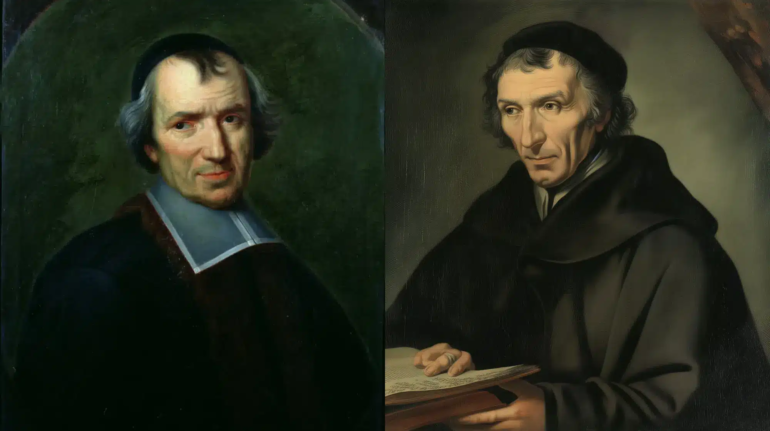
Historic portrait of Antoine Arnauld, showcasing the thoughtful expression of the 17th-century French philosopher and theologian known for his critical contributions to Jansenism and debates with Descartes.

Antoine Arnauld: A French Philosopher and Theologian

⚫Arnauld made significant contributions in the fields of philosophy, logic, and theology.
⚫The theological foundations greatly shaped his philosophical stances, especially because of his strong endorsement of Jansenism.
⚫Engaging in profound dialogues with influential thinkers such as Descartes and Malebranche, he greatly influenced contemporary discourse.
⚫His work explored the complex interplay between reason, faith, freedom of will, and moral responsibility.

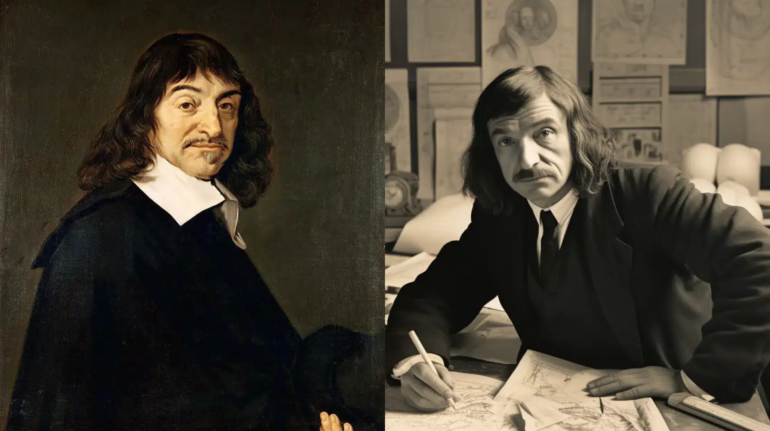
Painting of philosopher René Descartes with the Cartesian Coordinate System, symbolizing his contributions to modern philosophy and mathematics.

René Descartes: Father of Modern Philosophy & Mind-Body Dualism

⚫Descartes championed rationalism, emphasizing the primacy of reason in acquiring knowledge.
⚫He utilized radical skepticism to question existing beliefs and seek absolute certainty.
⚫In his exploration of the mind-body relationship, Descartes developed the theory of mind-body dualism.
⚫The Cartesian Coordinate System revolutionized geometry, laying the foundation for calculus.
⚫Descartes’ enduring legacy continues to influence philosophical debates on rationalism, empiricism, and the nature of knowledge.

Portrait of Thomas Hobbes with Leviathan concept - illustrating social contract theory and the foundation of state sovereignty.

Thomas Hobbes: Political Sovereignty and Social Contracts

⚫ Hobbes advocated for a strong central authority to maintain social order.
⚫ His philosophy emphasized the inherent selfishness and aggressiveness of individuals.
⚫ He proposed the social contract theory as a solution for governance.
⚫ Hobbes believed in the necessity of state sovereignty and absolute authority.
⚫Critiques include concerns about tyranny under absolute sovereign power and the suppression of freedoms.

portrait of Galileo Galilei in Renaissance attire, gazing intently towards the sky, with elements hinting at his astronomical discoveries.

The Age Of Science & Galileo Galilei’s Philosophical Legacy

⚫Galileo Galilei is a pioneer of modern science. His work in astronomy, physics, and philosophy laid the groundwork for scientific inquiry.
⚫He challenged the Earth-cantered view with his telescope, revealing a Sun-cantered solar system.
⚫He stressed experimentation. Galileo pioneered empirical science by verifying theories via observation and measurement.
⚫His work opposed Catholicism. Galileo’s heliocentrism and stress on reason clashed with religious authorities, exposing science’s conflict with faith.
⚫Modern science and philosophy were shaped by Galileo. His work in astronomy, physics, and science methods continues to influence science and philosophy.

illustration of Francis Bacon in a library, holding a scroll and an ethereal globe with scientific symbols, against a backdrop of celestial bodies, showcasing his role in advancing empirical methods.

Francis Bacon: Influence on Philosophy and Science

⚫Francis Bacon was a prominent figure in the transition from the Renaissance to the early modern era.
⚫He had a diverse career as a lawyer, member of Parliament, and Queens Counsel, and wrote on various topics such as law, state and religion, politics, society, and ethics.
⚫Bacon played an active role in the political aspects of religious conflicts and served on various committees.
⚫He rose to the highest political office as Lord Chancellor, but was later impeached by Parliament for corruption and lost all his offices and seat in Parliament.

Comic illustration depicting the evolution of moral thought from ancient Greek philosophy, through medieval religious teachings, the Enlightenment era, to modern digital challenges with symbols like justice scales, a globalisation globe, and technology icons.

The Decline of Ethics in the Digital Era

⚫Moral decay in modern times is influenced by various factors such as erosion of family structures, reliance on state institutions, and the rise of corporate greed and media portrayals.

⚫Technological advancements and the digital age have introduced new ethical concerns, including online privacy, machine morality, and the ethical implications of artificial intelligence and virtual reality.

⚫Social media plays a significant role in shaping morality, with concerns about privacy invasion, cyberbullying, online addiction, and the manipulation of perceptions and beliefs by influencers.

⚫Cultural shifts and modernization have challenged traditional norms and brought about tensions between religious traditions and human rights, as well as the prioritization of material wealth over ethical standards.

Renaissance painting of Niccolò Machiavelli strategizing over a chessboard, illustrating his influential tactics in governance and leadership.

Machiavelli’s Masterful Strategies: the Power of Pragmatic Philosophy

⚫At its core, his philosophy dissects the anatomy of power, leadership, and strategy, offering a pragmatic lens through which to view the world.
⚫He illuminates the complexities of human behaviour and governance, advocating for a leadership grounded in realism and adaptability.
⚫His discourse on power dynamics underscores the delicate balance between moral considerations and the pragmatic pursuit of goals.
⚫Pragmatism over Idealism: He champions a pragmatic approach, emphasizing the efficacy of adaptability and strategic planning in achieving success.
⚫Ethical Ambiguities: The philosophy grapples with ethical dilemmas, questioning the conventional boundaries of morality in the quest for power.
⚫Legacy of Realpolitik: His contributions lay the groundwork for the concept of Realpolitik, influencing political thought and leadership practices to this day.

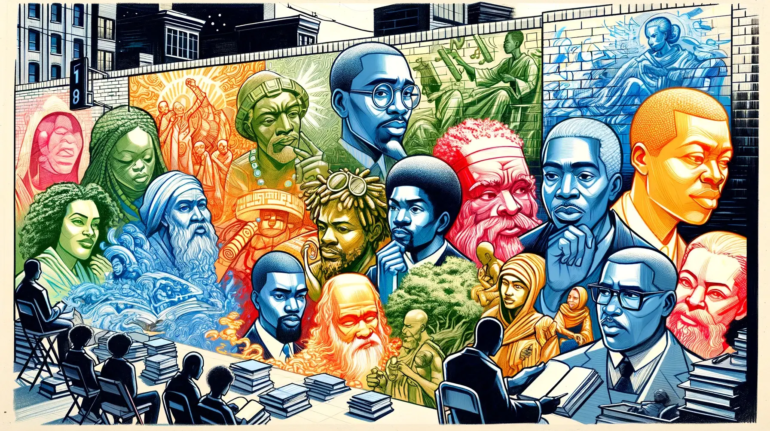
A wide-screen comic book sketch shows a vibrant mural in a bustling urban setting, highlighting renowned African philosophers deeply engrossed in contemplation. The first panel introduces the mural, serving as a beacon of wisdom. Subsequent panels focus on individual philosophers in dynamic poses, surrounded by symbols of their contributions—books, natural elements, and abstract ideas—each reflecting their profound engagement with philosophical questions.

African Philosophers: Unveiling Their Revolutionary Contributions

⚫African philosophy is rooted in the cultural and historical context of the continent, drawing from indigenous beliefs, oral traditions, and communal practices.
⚫African philosophers have made significant contributions to social justice by exploring issues such as colonialism, racism, gender inequality, and economic exploitation, and advocating for the recognition of African knowledge systems and marginalized voices.
⚫Contemporary African philosophers have enriched intellectual discourse and challenged traditional paradigms on topics such as the African diaspora, decolonial thought, environmental ethics, postcolonial theory, and social justice.
⚫African philosophers have contributed to postcolonial theory by examining the impacts of colonialism and imperialism, advocating for cultural revival and linguistic decolonization, and offering alternative perspectives that prompt critical reflections on social and political systems.