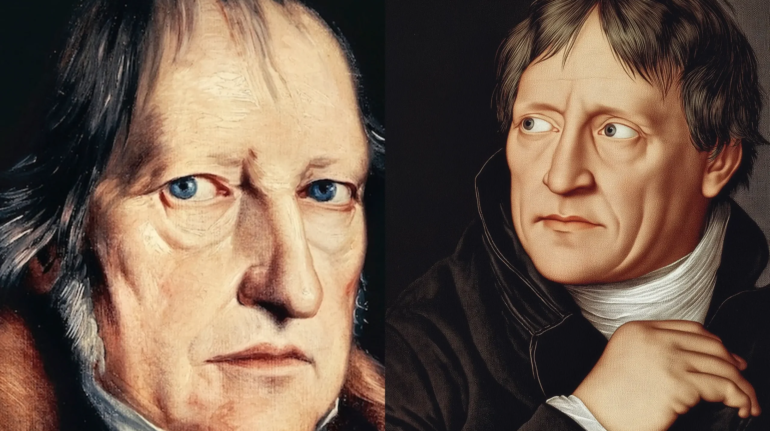
Portraits of German philosopher Georg Wilhelm Friedrich Hegel, a key figure in German Idealism and 19th-century philosophy, known for his dialectical method and the concept of the Absolute.

Hegel’s Philosophy: Geist, Dialectics, and History

⚫Hegel’s dialectical method involves a triadic structure: thesis, antithesis, synthesis, driving progress through contradictions.
⚫The Absolute Idea represents the ultimate truth, integrating finite and infinite elements in a dynamic, self-realising process.
⚫Geist, or collective human consciousness, evolves historically, reflecting the development of thought and society.
⚫Freedom is achieved through historical progression, culminating in a rational, ethical community or state.
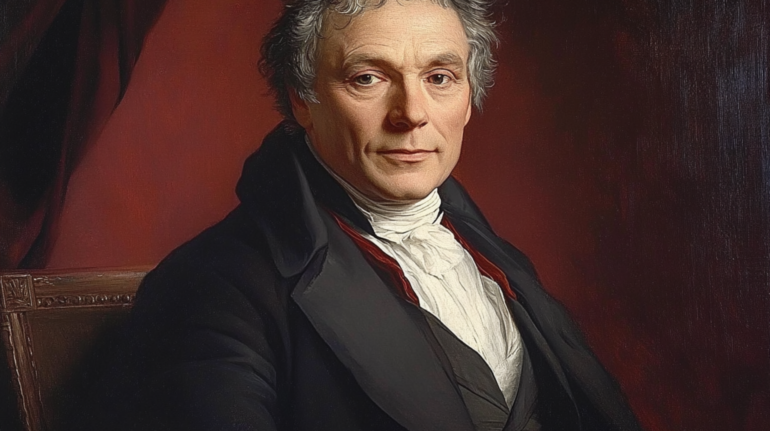
A classical portrait of Friedrich Wilhelm Joseph von Schelling, depicted in a dark 19th-century suit with a thoughtful expression, set against a warm, shadowed background in the style of Joseph Karl Stieler.

Friedrich Wilhelm Joseph Von Schelling: Philosophy of Nature, Mythology, and Identity

⚫Schelling’s Philosophy of Nature views nature as a dynamic, self-organising force driven by polar oppositions.
⚫His Identity Philosophy unifies self and world, highlighting the interconnectedness of all beings within the cosmos.
⚫The concept of the Absolute integrates subject and object, emphasising freedom and the evolving nature of existence.
⚫Schelling’s mythology explores cultural identity and consciousness, revealing metaphysical truths through mythological narratives.

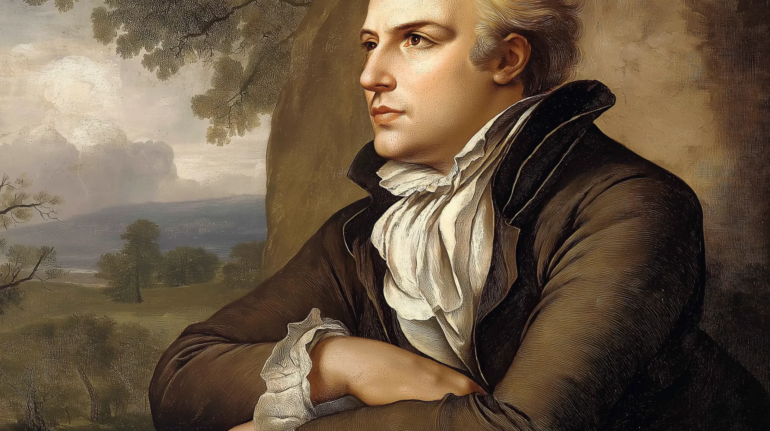
A high-quality reimagined portrait of Friedrich Schiller, the renowned German polymath known for his contributions as a poet, playwright, historian, philosopher, physician, and lawyer. The image captures Schiller's thoughtful expression as he gazes into the distance, symbolizing his deep engagement with themes of freedom, morality, and aesthetics.

Friedrich Schiller: Philosophy, Life, and Theory of Play

⚫Schiller’s literary works, such as The Robbers, critique social and political corruption and emphasise moral conflicts.

⚫He integrated Kant’s epistemology with Goethe’s intuition, enhancing the understanding of human nature and aesthetics.

⚫Schiller’s theory of play underscores the importance of aesthetic experiences in fostering creativity, imagination, and personal growth.

⚫He advocated for aesthetic education as essential for developing moral autonomy and intellectual capabilities.

⚫Schiller’s legacy bridges art, ethics, and human freedom, influencing contemporary discussions on freedom and creativity.

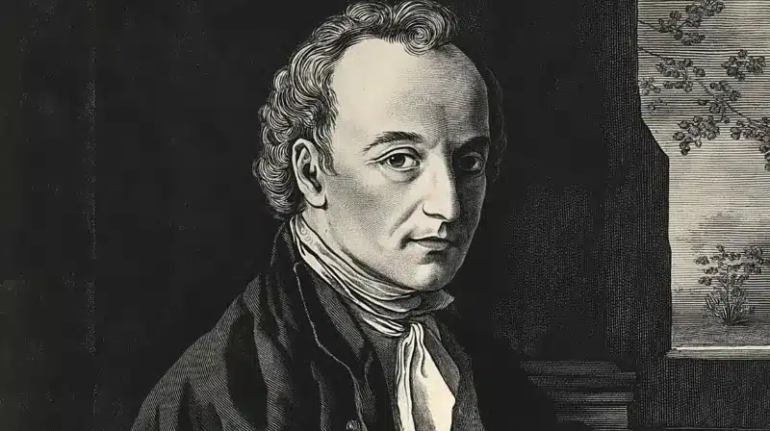
Image of Immanuel Kant, the German philosopher and idealist.

Immanuel Kant's Philosophy: Moral Ethics, God, and the Human Soul

⚫Kant’s Categorical Imperative underpins moral ethics, demanding actions be universally applicable and driven by duty.
⚫ Moral law points to God as an ultimate moral lawmaker guiding virtue towards bliss.
⚫According to Kant, moral excellence and perpetual happiness cannot be reached without the immortality of the soul.
⚫In Kant’s philosophy, autonomy is absolutely vital; moral actors treat humanity as an end and self-impose ethical rules.

Classical portrait of David Hume, the influential 18th-century philosopher, depicted in deep thought at his desk with books and writing materials.

David Hume's Philosophy: Theory, God and Solipsism

⚫Hume’s empiricism asserts all human ideas originate from sensory impressions, challenging abstract concepts and emphasising the need for empirical evidence.

⚫He is skeptical of miracles, arguing they lack credible empirical support and are often products of human psychological biases.

⚫Hume critiques traditional theistic arguments, highlighting the limits of human understanding in comprehending divinity and metaphysical concepts.

⚫His philosophy emphasises that ethical decisions are influenced by emotions and empathy rather than reason or religious doctrines.

Feature image of George Berkeley with tears and ethereal connections symbolizing his philosophy of phenomenalism, divine perception, and the rejection of materialism.

George Berkeley: Phenomenalism, God, and Our Senses

⚫Berkeley’s phenomenonlism posits that material objects exist only as perceptions in minds, rejecting their independent material existence.
God is the ultimate perceiver, ensuring that objects continue to exist even when humans are not able to perceive them.
⚫Perception is the immediate awareness of ideas within the mind, shaped by divine orchestration.
⚫Berkeley’s philosophy emphasises the interdependence of perception and reality, challenging materialist views of independent material substances.
⚫The coherence of perceived reality is maintained through God’s constant perception, underpinning Berkeley’s metaphysical and theological assertions.

Enlightenment-era classroom with diverse students and teacher illustrating Locke's influence on education and equality.

John Locke’s Empiricism: The Blank Slate Theory and Its Impact

⚫John Locke’s empiricism posits the mind as a ‘tabula rasa’ or blank slate at birth, devoid of innate ideas.
⚫Knowledge, according to Locke, comes from sensory experiences and reflection, not from pre-existing notions.
⚫Locke’s distinction between primary and secondary qualities shapes our perception and understanding of reality.
⚫The Blank Slate theory has had significant impacts on education, promoting equality and meritocracy over inherited social status.
⚫Locke’s empiricism played a critical role in the Scientific Revolution, emphasizing observation, experimentation, and the probabilistic nature of knowledge.

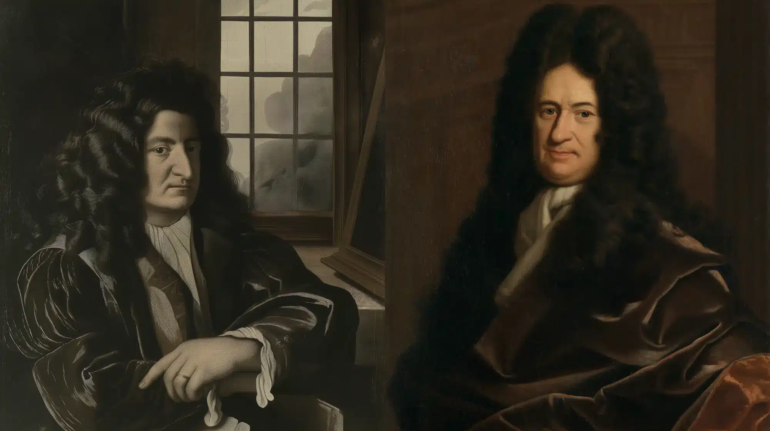
A portrait of Leibniz with a perplexed expression, next to a globe depicting a complex network of interconnected lines (symbolizing pre-established harmony).

Gottfried Leibniz: Optimism in a Complex World

⚫Gottfried Von Leibniz’s optimistic philosophy is based on the concepts of Monads, Pre-established Harmony, and the Principle of Sufficient Reason. ⚫Leibniz posited that we live in the ‘best of all possible worlds’, created by a benevolent God, despite the existence of evil and suffering.
⚫Critics, like Voltaire, have challenged Leibniz’s optimistic philosophy, arguing that it trivializes the harsh realities and suffering in the world.
⚫Despite critiques, Leibniz’s concepts have influenced contemporary philosophical discourse, particularly in areas of determinism, free will, and rationalism.
⚫Leibniz’s legacy extends beyond philosophy to mathematics, science, and computer science, where his work in binary systems and formal logic have shaped modern thinking.

Painting of Baruch Spinoza, a key figure in rationalist thought, sitting by a window that overlooks a natural landscape transitioning into a celestial scene, symbolizing his pantheistic view.

Benedict De Spinoza: Pantheism, Rationalism, and Democracy

⚫Spinoza’s pantheism equated God with nature, challenging traditional dualistic views and emphasizing universal interconnection.
⚫His rationalism prioritized reason over religious explanations, advocating for intellectual freedom and contributing to the Enlightenment.
⚫Spinoza believed the state was essential for social order, individual freedom, and advocated for religious tolerance.
⚫He supported a democratic form of government, separating religious authority from the state, influencing later political thought.
⚫His philosophy incorporated deterministic principles, linking understanding of the universe to ethical living and human happiness.

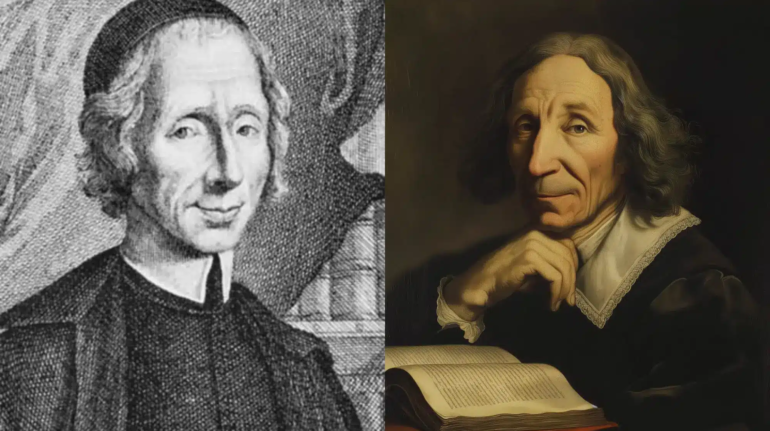
Artistic rendition of Nicolas Malebranche in a 17th-century study, writing intensely with a quill, surrounded by Baroque architecture and leather-bound books, with soft candlelight and a window overlooking the French countryside, symbolizing his philosophical integration of faith and reason.

Nicolas Malebranche: Why God Does All the Work (Occasionalism Explained)

⚫Malebranche’s philosophy aimed to reconcile reason with religious beliefs, integrating faith and rationality.
⚫His doctrine of occasionalism posits God as the primary cause, highlighting divine causation and bridging faith with causality.
⚫The ‘Vision in God’ doctrine shows Malebranche’s belief in divine illumination, suggesting truth and knowledge are perceived through God alone.
⚫Malebranche’s theodicy focuses on the origins of evil, asserting it stems from human deviation from divine order, thus merging faith and reason.
⚫His influence on Enlightenment determinism and theological discourse reflects his successful blending of faith and reason, impacting future generations’ understanding of these concepts.