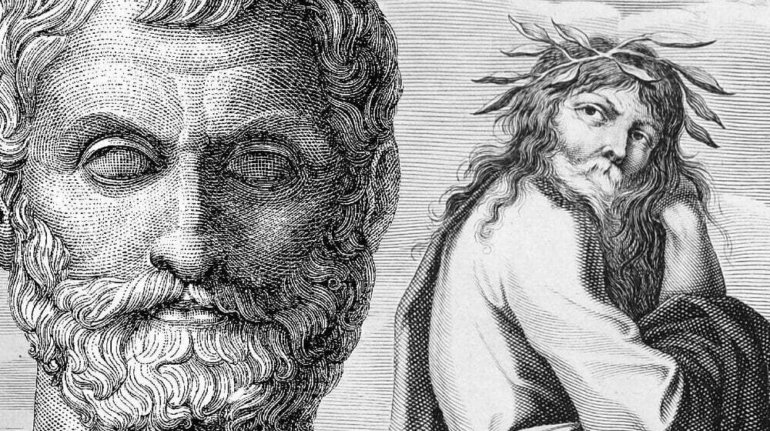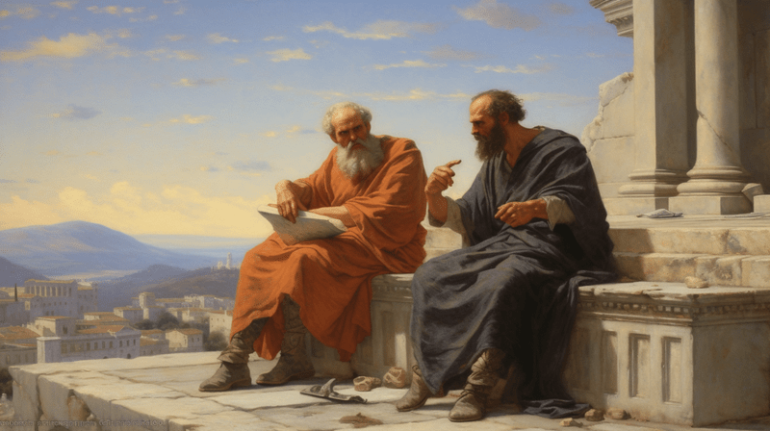
The Eleatics Revolution: Parmenides and Zeno's Discourse on Perception and Motion.

The Eleatics: Parmenides and Zeno of Elea

⚫ Parmenides and Zeno, the Eleatics, revolutionized philosophy with their exploration of logic, paradoxes, and metaphysics.
⚫ Parmenides proposed that reality is unchanging and that knowledge comes from rational reasoning, not sense perception.
⚫ Zeno, a student of Parmenides, used paradoxes to demonstrate that motion is an illusion caused by our perceptions.
⚫ The Eleatic school of thought, founded by Parmenides and continued by Zeno, had a profound influence on later philosophers like Plato and Aristotle.
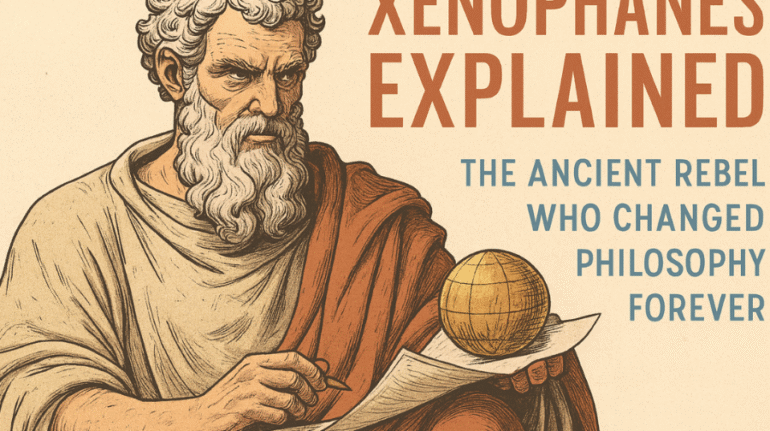
Minimalist vector illustration showing Xenophanes on a Mediterranean cliff with scroll in hand, golden orb symbolizing his one god concept, abstract knowledge symbols, and a historical timeline arc representing his influence.

Xenophanes: The Poet Who First Questioned the Gods

⚫ Xenophanes of Colophon (570-475 BCE) was ancient Greece’s first rebel philosopher who challenged the gods themselves, transforming from poet to philosopher and becoming arguably the world’s first monotheist.
⚫ Born in intellectual hotspot Colophon, he spent 60+ years traveling the Mediterranean, using revolutionary poetry to attack conventional wisdom, famously arguing that if horses could draw, they’d depict horse-like gods.
⚫ His critique of Greek religion was both logical and courageous, exposing anthropomorphic absurdities and challenging Homer’s portrayal of gods as thieves and adulterers while proposing one supreme god “unlike mortals in form or thought.”
⚫ Xenophanes pioneered sophisticated thinking about knowledge, declaring absolute certainty impossible while maintaining “by seeking, humans find out better in time” — combining intellectual humility with scientific optimism that remains remarkably modern.

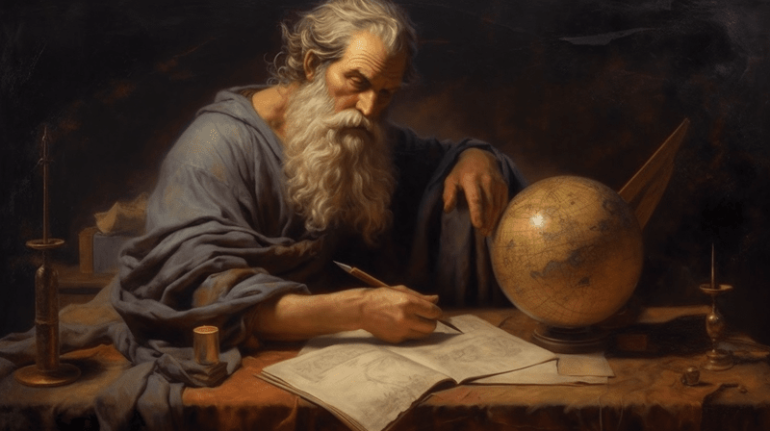
an image featuring a silhouette of Pythagoras contemplating a geometric diagram with a celestial, metaphysical background.

Pythagoras: Mathematician, Mystic, Cult Leader (Philosophy & Legacy)

⚫Pythagoras’s contributions extend beyond textbooks and can be seen in architecture, music, and cosmic mysteries.
⚫His philosophy emphasized harmony and personal discipline, which are still highly regarded today.
⚫Pythagoras advocated for vegetarianism based on his belief in the transmigration of souls and saw all life as interconnected.
⚫Despite not writing any books, Pythagoras left a lasting impression on human knowledge, particularly in mathematics and metaphysics.

A classic painting by Wilhelm Meyer, depicting a serene landscape with lush green trees, a calm river, and a picturesque countryside, reflecting the artist's mastery in capturing the beauty of nature. Image is in the public domain and available via Wikimedia Commons.

Thales of Miletus: The Pioneering Dawn of Western Philosophy (Facts & Bio)

⚫ Thales of Miletus was the first philosopher in the Greek tradition and made significant contributions to philosophy, mathematics, and astronomy.
⚫ He believed in using reason and observation to understand the universe, challenging traditional supernatural explanations.
⚫ Thales proposed that water was the origin of all things, shifting perspectives on cosmological interpretations.
⚫ His revolutionary ideas and application of principles from astronomy had real-world implications for navigation, architecture, farming, and laid the foundation for future geometric studies and deductive reasoning.

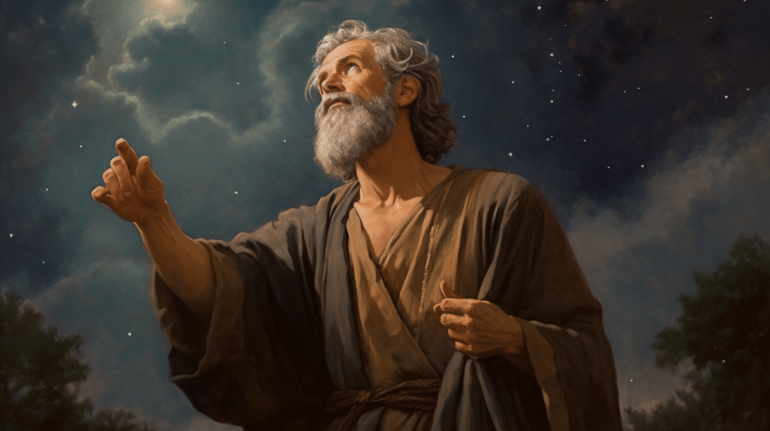
A high-resolution photograph of Thales of Miletus in ancient Greek-style clothing, standing atop a rocky cliff, gazing outward to the horizon, with the sea in the background.

Ancient Philosophers: The Presocratic

⚫ The Pre-socratics shifted from mythological to naturalistic explanations, laying the groundwork for modern philosophy. ⚫ Key figures like Thales and Anaximander led this transformative era with their unique perspectives. ⚫ Their ideas reveal early Greek speculation about cosmology, influencing later thinkers like Plato and Aristotle. ⚫ Thales of Miletus argued against mythology, proposing water as the fundamental basis of all matter. ⚫ Anaximander proposed all matter arose from ‘the infinite’, emphasizing naturalism and setting the stage for future philosophies.

"The Unity of Existence: Parmenides and the Stone" by Midjourney/abjuniormnea

Unveiling Truth: Parmenides’ Bold Stand Against the Illusion of Change

⚫Parmenides of Elea was an ancient Greek philosopher who founded the Eleatic School and revolutionized Greek philosophy.
⚫Parmenides believed in the concept of immutable reality and argued against the idea of things coming into being or ceasing to exist.
⚫He believed that the physical world we perceive as changing is merely an illusion and that reality is static and unchanging.
⚫Parmenides’ primary work, a poem, raises profound questions about existence, reality, and the nature of change, challenging our understanding of reality itself.

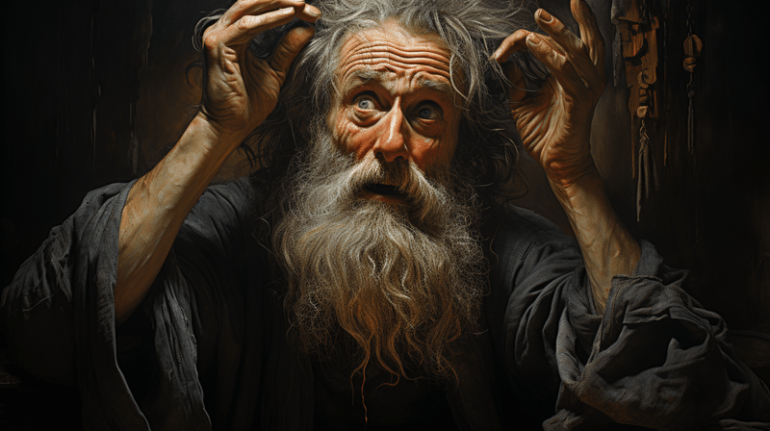
A renewed painting of Heraclitus, the Weeping Philosopher.

Heraclitus: ‘You Cannot Step in the Same River Twice’ Explained

⚫Change is a constant reality in our lives, and embracing it is necessary for growth and personal development.

⚫The Heraclitus Paradigm encourages us to see change as an opportunity rather than a threat and to let go of old habits.

⚫ Balance is about embracing change while maintaining stability and finding harmony within oneself.

⚫ Strategies for adapting to change include adaptability training, cultivating emotional resilience, and embracing changes in work and personal life.