A visual pencil sketch of Plato with a pensive expression of his face. and Aristotle his student.

Aristotle Vs Plato: A Critique of Their Philosophies

⚫Plato’s Theory of Forms suggests a perfect, abstract realm, criticised for its detachment from observable reality.
⚫Aristotle grounds knowledge in empirical observation, critiquing Plato’s abstract idealism.
⚫Plato idealises a rigid class-based society in ‘The Republic’, which some view as impractical and authoritarian.
⚫Aristotle’s focus on practical ethics and politics contrasts with Plato’s emphasis on abstract, ideal forms of governance.
⚫Aristotle’s methodologies in science, emphasising observation and categorization, laid groundwork for modern empirical research, challenging Plato’s metaphysical focus.
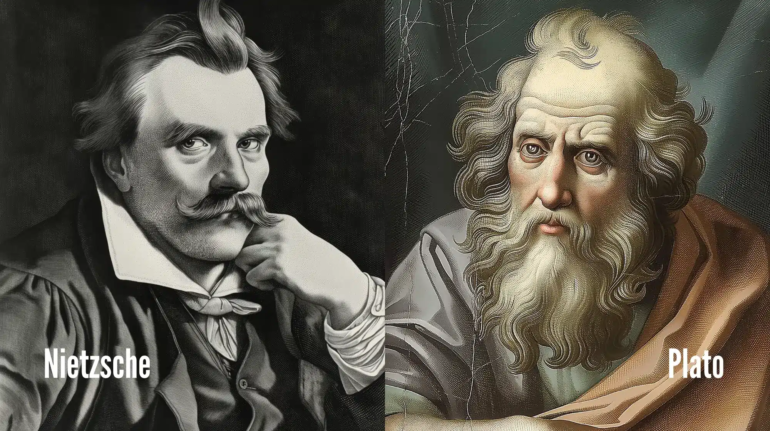
Artistic representation of Friedrich Nietzsche in debate with Plato and Socrates, symbolizing the clash of modern and classical philosophical ideals.

Why did Nietzsche call Plato and Socrates the ruins of philosophy?

⚫Nietzsche believed Socrates and Plato overemphasised rationalism, stifling creativity and dynamism in philosophy.
⚫He criticised their pursuit of absolute truth, which marginalised subjective, individual experiences.
⚫Plato’s idealism, separating the material from the ideal, devalued the physical world and human senses.
⚫Their philosophies promoted dualism, leading to a negative, life-denying outlook and suppressing individual creativity.
⚫By prioritising reason over other human aspects, they established rigid, less flexible philosophical systems.

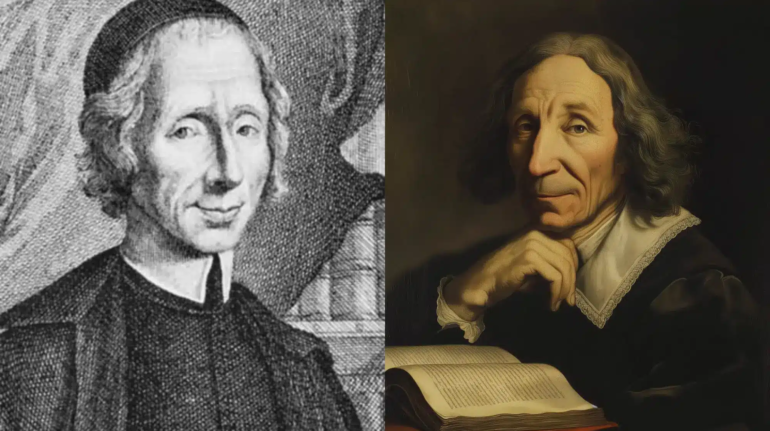
Painting of Baruch Spinoza, a key figure in rationalist thought, sitting by a window that overlooks a natural landscape transitioning into a celestial scene, symbolizing his pantheistic view.

Benedict De Spinoza: Pantheism, Rationalism, and Democracy

⚫Spinoza’s pantheism equated God with nature, challenging traditional dualistic views and emphasizing universal interconnection.
⚫His rationalism prioritized reason over religious explanations, advocating for intellectual freedom and contributing to the Enlightenment.
⚫Spinoza believed the state was essential for social order, individual freedom, and advocated for religious tolerance.
⚫He supported a democratic form of government, separating religious authority from the state, influencing later political thought.
⚫His philosophy incorporated deterministic principles, linking understanding of the universe to ethical living and human happiness.

Artistic rendition of Nicolas Malebranche in a 17th-century study, writing intensely with a quill, surrounded by Baroque architecture and leather-bound books, with soft candlelight and a window overlooking the French countryside, symbolizing his philosophical integration of faith and reason.

Nicolas Malebranche: Why God Does All the Work (Occasionalism Explained)

⚫Malebranche’s philosophy aimed to reconcile reason with religious beliefs, integrating faith and rationality.
⚫His doctrine of occasionalism posits God as the primary cause, highlighting divine causation and bridging faith with causality.
⚫The ‘Vision in God’ doctrine shows Malebranche’s belief in divine illumination, suggesting truth and knowledge are perceived through God alone.
⚫Malebranche’s theodicy focuses on the origins of evil, asserting it stems from human deviation from divine order, thus merging faith and reason.
⚫His influence on Enlightenment determinism and theological discourse reflects his successful blending of faith and reason, impacting future generations’ understanding of these concepts.

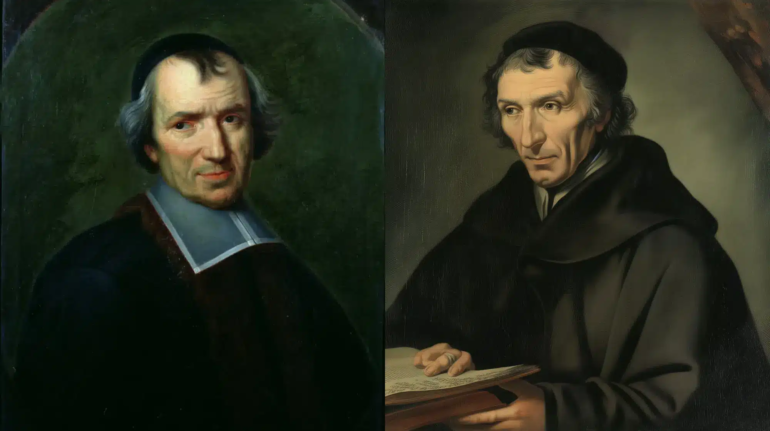
Historic portrait of Antoine Arnauld, showcasing the thoughtful expression of the 17th-century French philosopher and theologian known for his critical contributions to Jansenism and debates with Descartes.

Antoine Arnauld: A French Philosopher and Theologian

⚫Arnauld made significant contributions in the fields of philosophy, logic, and theology.
⚫The theological foundations greatly shaped his philosophical stances, especially because of his strong endorsement of Jansenism.
⚫Engaging in profound dialogues with influential thinkers such as Descartes and Malebranche, he greatly influenced contemporary discourse.
⚫His work explored the complex interplay between reason, faith, freedom of will, and moral responsibility.

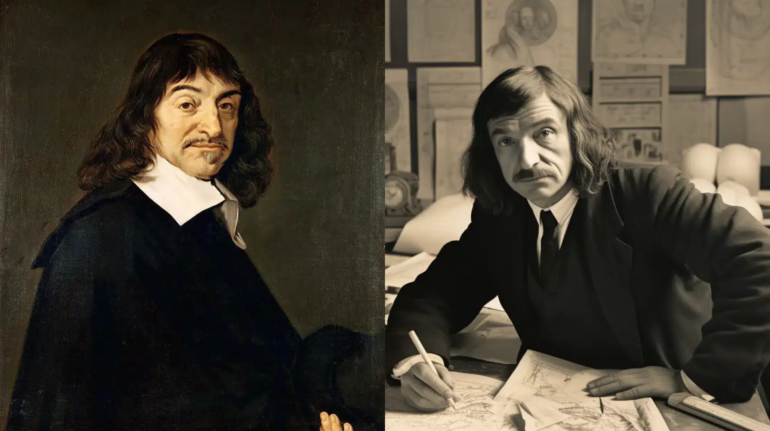
Painting of philosopher René Descartes with the Cartesian Coordinate System, symbolizing his contributions to modern philosophy and mathematics.

René Descartes: Father of Modern Philosophy & Mind-Body Dualism

⚫Descartes championed rationalism, emphasizing the primacy of reason in acquiring knowledge.
⚫He utilized radical skepticism to question existing beliefs and seek absolute certainty.
⚫In his exploration of the mind-body relationship, Descartes developed the theory of mind-body dualism.
⚫The Cartesian Coordinate System revolutionized geometry, laying the foundation for calculus.
⚫Descartes’ enduring legacy continues to influence philosophical debates on rationalism, empiricism, and the nature of knowledge.

Portrait of Thomas Hobbes with Leviathan concept - illustrating social contract theory and the foundation of state sovereignty.

Thomas Hobbes: Political Sovereignty and Social Contracts

⚫ Hobbes advocated for a strong central authority to maintain social order.
⚫ His philosophy emphasized the inherent selfishness and aggressiveness of individuals.
⚫ He proposed the social contract theory as a solution for governance.
⚫ Hobbes believed in the necessity of state sovereignty and absolute authority.
⚫Critiques include concerns about tyranny under absolute sovereign power and the suppression of freedoms.

portrait of Galileo Galilei in Renaissance attire, gazing intently towards the sky, with elements hinting at his astronomical discoveries.

The Age Of Science & Galileo Galilei’s Philosophical Legacy

⚫Galileo Galilei is a pioneer of modern science. His work in astronomy, physics, and philosophy laid the groundwork for scientific inquiry.
⚫He challenged the Earth-cantered view with his telescope, revealing a Sun-cantered solar system.
⚫He stressed experimentation. Galileo pioneered empirical science by verifying theories via observation and measurement.
⚫His work opposed Catholicism. Galileo’s heliocentrism and stress on reason clashed with religious authorities, exposing science’s conflict with faith.
⚫Modern science and philosophy were shaped by Galileo. His work in astronomy, physics, and science methods continues to influence science and philosophy.

illustration of Francis Bacon in a library, holding a scroll and an ethereal globe with scientific symbols, against a backdrop of celestial bodies, showcasing his role in advancing empirical methods.

Francis Bacon: Influence on Philosophy and Science

⚫Francis Bacon was a prominent figure in the transition from the Renaissance to the early modern era.
⚫He had a diverse career as a lawyer, member of Parliament, and Queens Counsel, and wrote on various topics such as law, state and religion, politics, society, and ethics.
⚫Bacon played an active role in the political aspects of religious conflicts and served on various committees.
⚫He rose to the highest political office as Lord Chancellor, but was later impeached by Parliament for corruption and lost all his offices and seat in Parliament.