Renaissance painting of Niccolò Machiavelli strategizing over a chessboard, illustrating his influential tactics in governance and leadership.

Machiavelli’s Masterful Strategies: the Power of Pragmatic Philosophy

⚫At its core, his philosophy dissects the anatomy of power, leadership, and strategy, offering a pragmatic lens through which to view the world.
⚫He illuminates the complexities of human behaviour and governance, advocating for a leadership grounded in realism and adaptability.
⚫His discourse on power dynamics underscores the delicate balance between moral considerations and the pragmatic pursuit of goals.
⚫Pragmatism over Idealism: He champions a pragmatic approach, emphasizing the efficacy of adaptability and strategic planning in achieving success.
⚫Ethical Ambiguities: The philosophy grapples with ethical dilemmas, questioning the conventional boundaries of morality in the quest for power.
⚫Legacy of Realpolitik: His contributions lay the groundwork for the concept of Realpolitik, influencing political thought and leadership practices to this day.
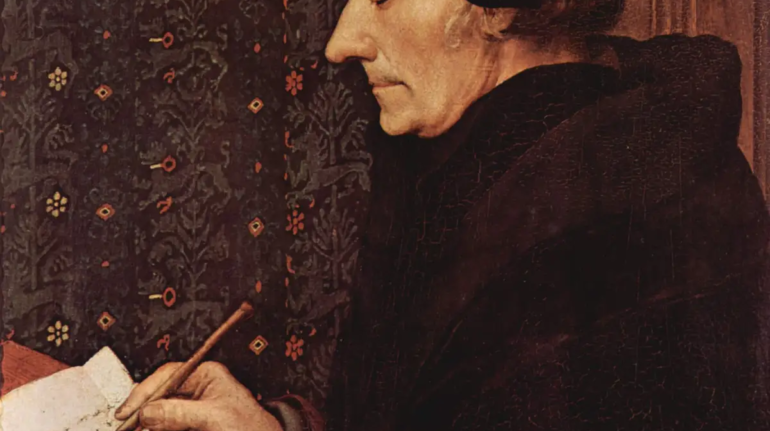
Historical portrait of Erasmus of Rotterdam, symbolizing his profound influence as a Renaissance humanist and philosopher, dressed in traditional garb of the era, with a thoughtful expression, epitomizing intellectual curiosity and scholarly pursuit.

Erasmus: Defying Orthodox Beliefs

⚫Erasmus pushed the limits of philosophy by exploring various traditions, including Platonism and Epicureanism.
⚫ He held the firm conviction that philosophy carried a moral responsibility for every individual, and thus, he established a code of conduct for communication to steer himself and others towards the genuine pursuit of wisdom.
⚫ Erasmus worked alongside influential individuals like Thomas More, John Colet, Aldus Manutius, and Johann Froben on a range of intellectual projects.
⚫ Despite the controversies and disagreements with theologians such as Martin Luther, Erasmus was a strong advocate for Church unity through conciliation. He firmly refused to align himself with the Protestant reformers.

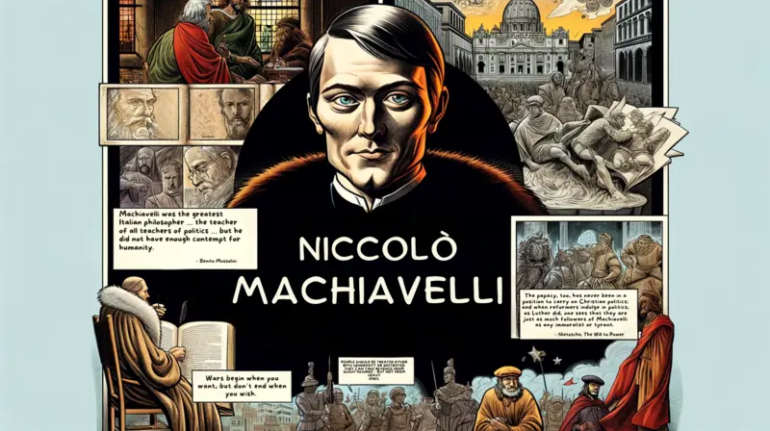
Portrait of Niccolò Machiavelli, depicting the influential Renaissance philosopher and statesman, symbolizing his enduring impact on modern thought.

Niccolò Machiavelli: The Realist Who Redefined Power and Politics

⚫ Machiavelli’s most famous work, “The Prince,” focuses on the techniques a successful politician must use to achieve their political ends, without regard to the moral justification of those means.
⚫ The ends justify the means in Machiavellian technique, meaning that if the political ends are considered good, it doesn’t matter how they are achieved.
⚫ Machiavelli believes that three primary political goods are national security, national independence, and a strong constitution.
⚫ Manipulation of others, including the populace, for power is at the heart of Machiavelli’s teachings, and appearing virtuous can often serve one’s political ends.

Nicolaus Copernicus portrait from Town Hall in Toruń - 1580, District Museum in Toruń, Public domain, via Wikimedia Commons

Copernicus to Newton: Galactic Science Breakthrough

⚫ Copernicus’s Heliocentric Model provided the catalyst for the age of Renaissance. ⚫The theory placed the Sun, not the Earth, at the centre of our solar system, challenging centuries of Aristotelian thought. ⚫This in turns provided significant contributions to astronomy, including the eccentric computational astronomy and celestial mechanics, setting the stage for future scientific advancements. ⚫Copernicus’s ideas inspired subsequent luminaries like Galileo Galilei, Johannes Kepler, and Sir Isaac Newton, each building upon his heliocentric theory in their respective fields.

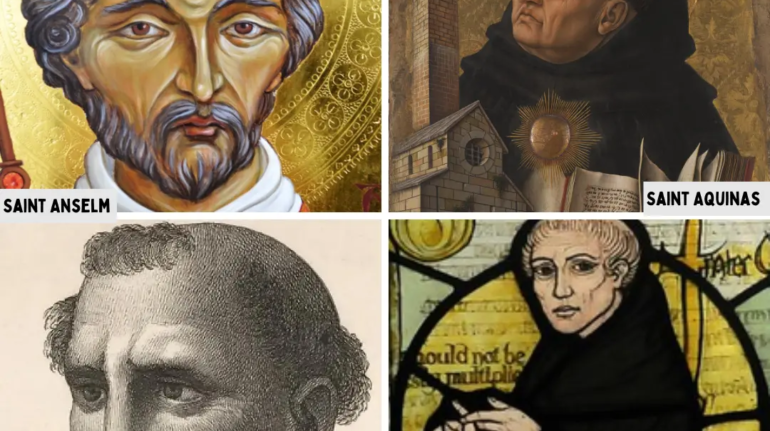
Collage depicting Saint Anselm, Thomas Aquinas, John Duns Scotus, and William of Ockham in a medieval study, symbolizing their contributions to philosophy and theology.

The Scholastics: Anselm to Occam Insights

⚫ Medieval Scholastics like Saint Anselm, Aquinas, Scotus, and Occam influenced modern thought in philosophy, religion, and science. ⚫ Saint Anselm’s “Proslogion” explored God’s existence and nature; discussed free will and determinism. ⚫ Thomas Aquinas synthesized Aristotelian thought with Christian theology in “Summa Theologica.” ⚫ John Duns Scotus, known for ‘Scotism’, debated divine omnipotence and ethics. ⚫ William of Ockham, noted for ‘Occam’s Razor’, emphasized logical simplicity. ⚫ Scholastic Movement blended Christian and philosophical ideas, impacting religious studies. Scholastics’ ideas contributed to the Renaissance and modern philosophical and scientific thought.

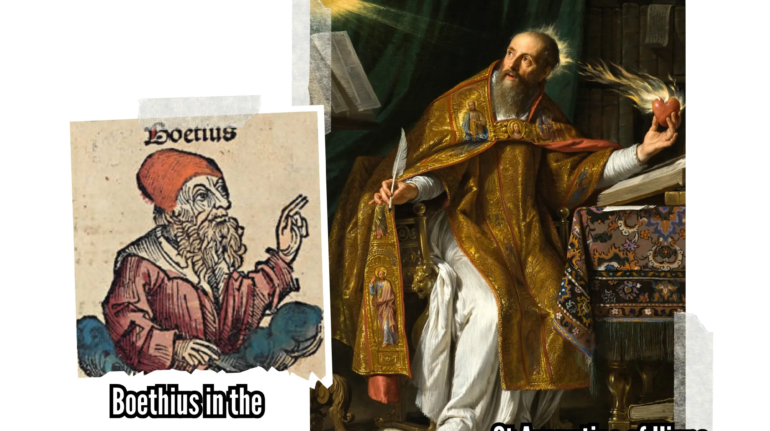
A collage of saint Boethius and Saint Augustine art by Michel Wolgemut, Wilhelm Pleydenwurff and Philippe de Champaigne, Public domain

Augustine & Boethius: Insights and Legacy

⚫ Saint Augustine of Hippo was influential in blending philosophical ideas from Greek traditions with Christian thought, providing a unique perspective on issues like morality, the nature of the soul, and divine providence.
⚫ Both Augustine and Boethius were significantly influenced by Greek philosophers such as Plato and Aristotle. This influence is evident in their approach to understanding reality, the concept of the divine, and the human quest for knowledge and truth.
⚫St. Augustine’s contributions to Christian theology are vast, covering topics like original sin, predestination, grace, and free will. Boethius’ work also delved into similar themes, providing foundational ideas for Western Christian thought.
⚫Augustine and Boethius successfully synthesized philosophical reasoning with religious faith. This synthesis created a comprehensive worldview that addressed both the nature of the divine and the role of humans in relation to it.
⚫The enduring legacy of Augustine and Boethius in shaping Christian belief and philosophy is a prominent theme. Their ideas continue to influence theological and philosophical discussions, emphasizing the timeless nature of their contributions.
⚫The relevance of Augustine and Boethius’ ideas in contemporary discussions on ethics, morality, and spirituality is also highlighted. Their perspectives offer insights into modern life, providing guidance in navigating complex ethical and philosophical dilemmas.

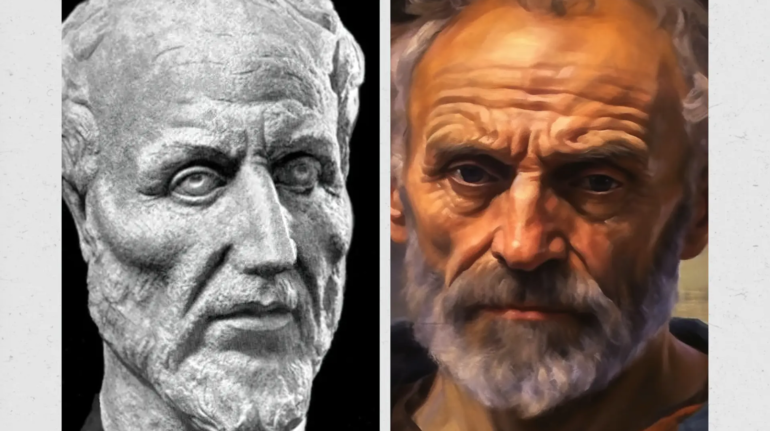
A collage featuring a classical sculpture of Plotinus on the left and a modern artistic rendition of him on the right.

Plotinus: The Philosopher Who Saw God in Mathematics

⚫Neoplatonism is intertwined with various philosophies such as Plato’s dualism, Aristotle’s logic, Stoicism’s ethics, Augustine’s Christianity, and Gnosticism’s mysticism. It synthesizes elements from these philosophies, creating a unified view of reality and existence beyond death. ⚫Plotinus views death as a transition, not an endpoint. Souls, based on their earthly lives, go through stages in the afterlife, with enlightened souls transcending the physical realm and unifying with ‘the One’. ⚫Followers like Proclus, Porphyry, and Iamblichus contributed significantly to Neoplatonism, each bringing unique perspectives and developments, ensuring the philosophy’s continuity and evolution. ⚫Plotinus’ ideas of unity and the soul’s journey towards spiritual truth continue to resonate, offering both philosophical insights into existence beyond the physical and practical guidance for harmonious living.

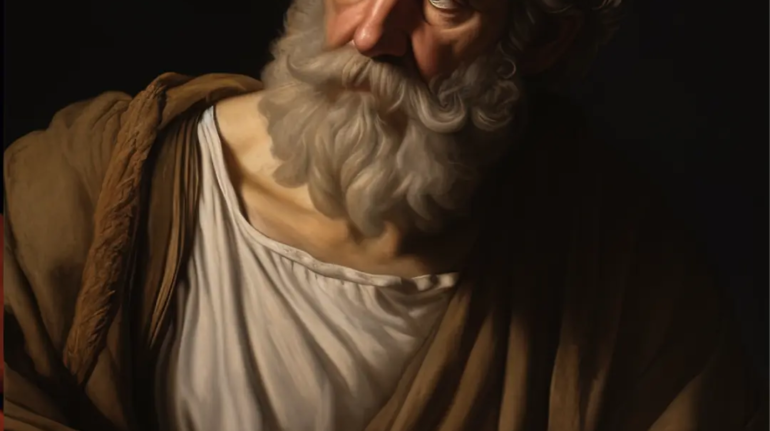
Close-up portrait of Sextus Empiricus with a thoughtful expression, illuminated by soft lighting. Painted in earthy colors of blues, browns, and whites, capturing the depth and texture in Artemisia Gentileschi's style.

Sextus Empiricus: Skepticism’s Transformative Wisdom

⚫ Academic Skepticism: This concept involves the constant questioning of all things. Sextus Empiricus advocated for a stance of uncertainty due to the absence of absolute knowledge or truth in the world.⚫ Key Concepts: Pyrrhonian Skepticism and Modified Pyrrhonism are presented as powerful frameworks for critical inquiry, encouraging a continuous exploration of truth and knowledge.⚫ Real-World Application: Skepticism in the real world fosters critical thinking and open-mindedness across various life aspects, showcasing its practical relevance and utility.

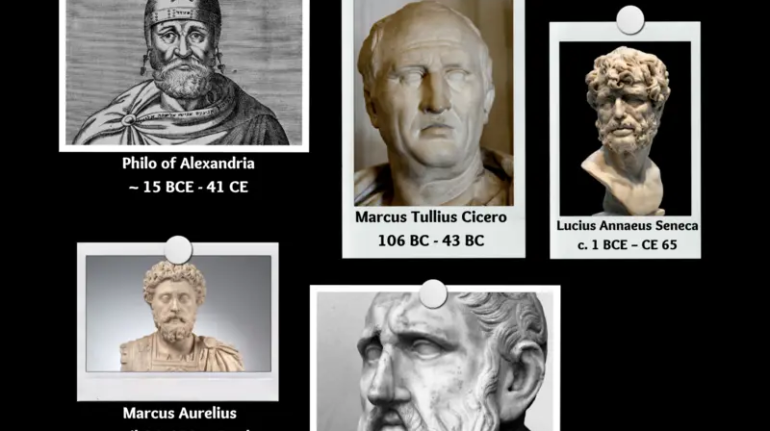
Collage of major figures in Stoic Philosophy

The 15 Core Stoic Principles (And Why They Still Work Today)

⚫Stoicism, rooted in virtue and resilience, is explored through the lenses of Cicero, Philo, Seneca, and Aurelius, each contributing unique interpretations and applications of Stoic principles.

⚫The historical journey of Stoicism is traced, highlighting its evolution and enduring influence across various epochs, including its resurgence in modern times.

⚫Core Stoic principles such as ethics, logic, and physics are dissected, providing a roadmap to achieving tranquillity and moral excellence amidst life’s tumult.

⚫The individual beliefs and teachings of each philosopher are meticulously examined, offering a rich tapestry of Stoic thought and its practical application in navigating life’s adversities.