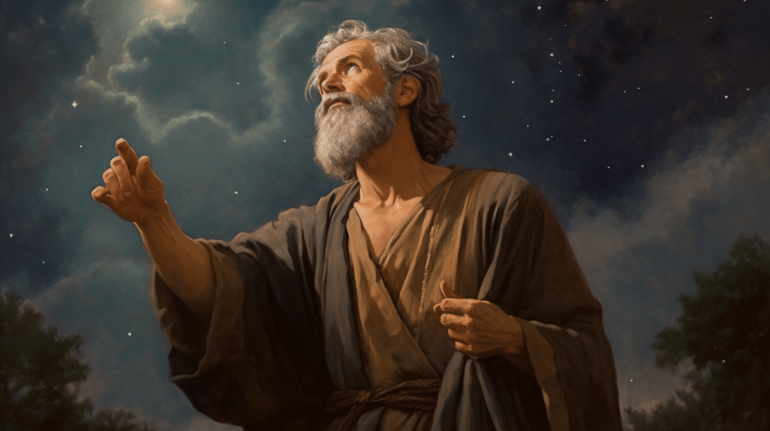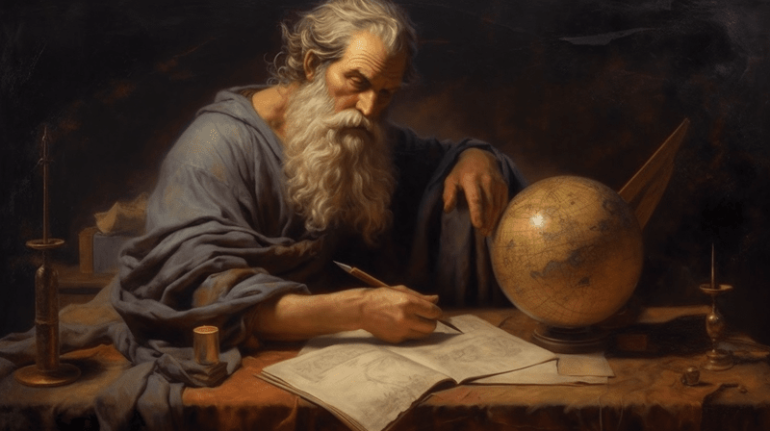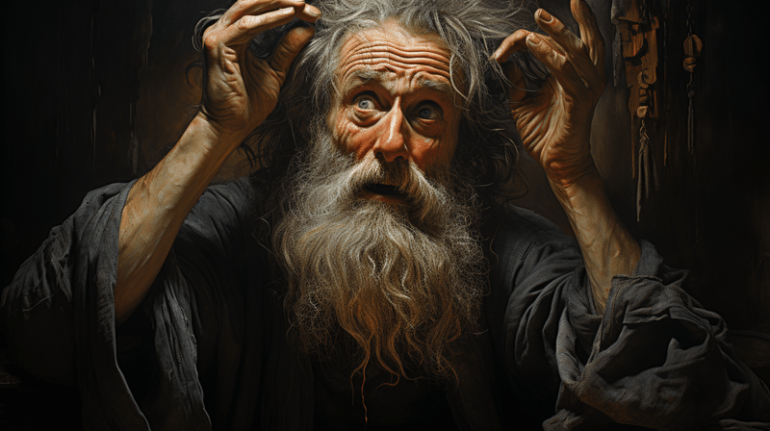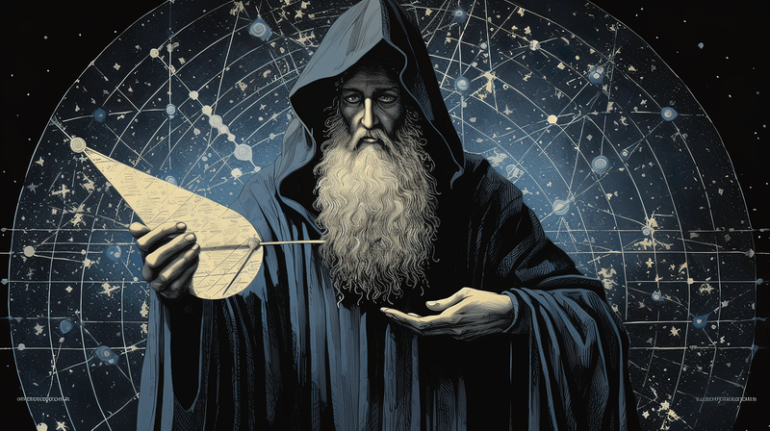
an image featuring a silhouette of Pythagoras contemplating a geometric diagram with a celestial, metaphysical background.

Pythagoras: Mathematician, Mystic, Cult Leader (Philosophy & Legacy)

⚫Pythagoras’s contributions extend beyond textbooks and can be seen in architecture, music, and cosmic mysteries.
⚫His philosophy emphasized harmony and personal discipline, which are still highly regarded today.
⚫Pythagoras advocated for vegetarianism based on his belief in the transmigration of souls and saw all life as interconnected.
⚫Despite not writing any books, Pythagoras left a lasting impression on human knowledge, particularly in mathematics and metaphysics.
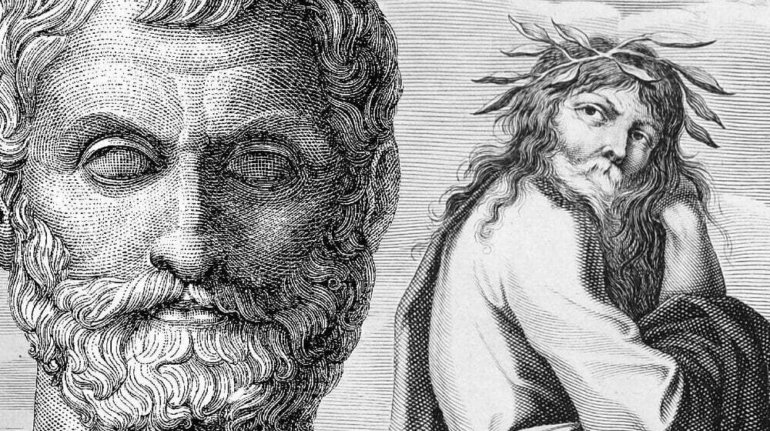
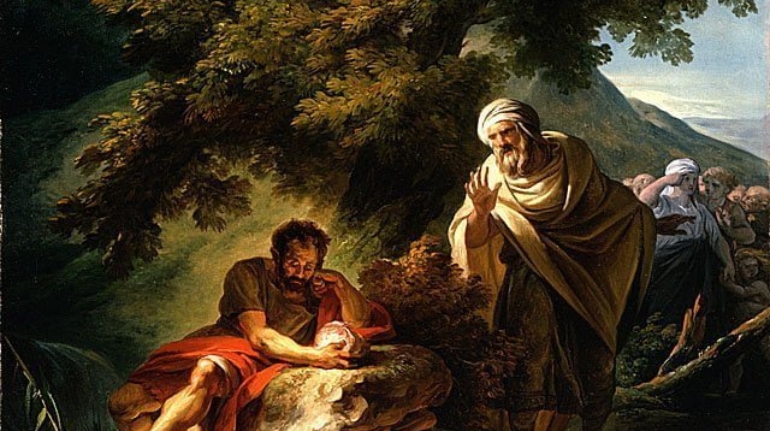
A classic painting by Wilhelm Meyer, depicting a serene landscape with lush green trees, a calm river, and a picturesque countryside, reflecting the artist's mastery in capturing the beauty of nature. Image is in the public domain and available via Wikimedia Commons.

Thales of Miletus: The Pioneering Dawn of Western Philosophy (Facts & Bio)

⚫ Thales of Miletus was the first philosopher in the Greek tradition and made significant contributions to philosophy, mathematics, and astronomy.
⚫ He believed in using reason and observation to understand the universe, challenging traditional supernatural explanations.
⚫ Thales proposed that water was the origin of all things, shifting perspectives on cosmological interpretations.
⚫ His revolutionary ideas and application of principles from astronomy had real-world implications for navigation, architecture, farming, and laid the foundation for future geometric studies and deductive reasoning.

Democritus and Epicurus, the ancient Greek philosophers, François-André Vincent painting, revolutionized the understanding of the universe through their atomist theory.

Democritus & Epicurus: Pioneers of Revolutionary Enlightenment in Philosophy

⚫ Democritus and Epicurus, ancient Greek philosophers, laid the foundation of atomism, asserting that the universe is composed of indivisible atoms.
⚫ Their ground-breaking theories have profoundly impacted modern science, especially physics and chemistry.
⚫ Epicurus built upon Democritus’s ideas, introducing concepts like “atom-swerve” and emphasizing human freedom and the pursuit of pleasure.
⚫ The atomist theory continues to influence contemporary thought, bridging ancient wisdom with modern scientific inquiry.

A Portrait of Nietzsche standing at a looking glass

Things Nietzsche Philosophy Never Said

⚫ Explore the commonly misunderstood aspects of Friedrich Nietzsche’s philosophy, as we dive into ’15 Things Nietzsche Philosophy Never Said’, to gain a deeper grasp of his authentic beliefs and intentions. ⚫ Navigate the era of information overload, where distinguishing fact from fiction can be daunting, and discover the importance of scrutinizing these misconceptions to enrich our knowledge. ⚫ Join us in an enlightening journey, where we uncover Nietzsche’s true statements and separate them from the ideas erroneously attributed to him, paving the way for intellectual and spiritual growth. ⚫ Dive into the captivating life story of Nietzsche, highlighting his early curiosity, academic.

A high-resolution photograph of Thales of Miletus in ancient Greek-style clothing, standing atop a rocky cliff, gazing outward to the horizon, with the sea in the background.

Ancient Philosophers: The Presocratic

⚫ The Pre-socratics shifted from mythological to naturalistic explanations, laying the groundwork for modern philosophy. ⚫ Key figures like Thales and Anaximander led this transformative era with their unique perspectives. ⚫ Their ideas reveal early Greek speculation about cosmology, influencing later thinkers like Plato and Aristotle. ⚫ Thales of Miletus argued against mythology, proposing water as the fundamental basis of all matter. ⚫ Anaximander proposed all matter arose from ‘the infinite’, emphasizing naturalism and setting the stage for future philosophies.

"The Unity of Existence: Parmenides and the Stone" by Midjourney/abjuniormnea

Unveiling Truth: Parmenides’ Bold Stand Against the Illusion of Change

⚫Parmenides of Elea was an ancient Greek philosopher who founded the Eleatic School and revolutionized Greek philosophy.
⚫Parmenides believed in the concept of immutable reality and argued against the idea of things coming into being or ceasing to exist.
⚫He believed that the physical world we perceive as changing is merely an illusion and that reality is static and unchanging.
⚫Parmenides’ primary work, a poem, raises profound questions about existence, reality, and the nature of change, challenging our understanding of reality itself.

A renewed painting of Heraclitus, the Weeping Philosopher.

Heraclitus: ‘You Cannot Step in the Same River Twice’ Explained

⚫Change is a constant reality in our lives, and embracing it is necessary for growth and personal development.

⚫The Heraclitus Paradigm encourages us to see change as an opportunity rather than a threat and to let go of old habits.

⚫ Balance is about embracing change while maintaining stability and finding harmony within oneself.

⚫ Strategies for adapting to change include adaptability training, cultivating emotional resilience, and embracing changes in work and personal life.